Two Kids In A Sand Box [updated] Jun 2026

The older kids were charmed by the two kids' enthusiasm, and they decided to join in on the fun. Together, they built an entire city, complete with roads, buildings, and even a working drawbridge.

And with that, the two kids continued to play and create, their imaginations running wild in the sandbox kingdom.

Leo, age six, was the architect. He wore a blue t-shirt with a faded rocket ship on the front, now dusted with a layer of fine grain. He was entirely focused on the engineering feat before him: a elaborate network of tunnels that required absolute precision. His brow was furrowed, his tongue poking out slightly in concentration. He didn't just dig; he excavated. He scooped with a bright yellow shovel, moving earth bucket by bucket to build a fortress wall. two kids in a sand box

There is a specific kind of silence that happens when two children are deep in the "flow" of sand play. It isn’t a lack of noise, but a presence of shared focus. One child, a four-year-old with a smudge of dirt on his nose, carefully patting a plastic bucket. The other, slightly older, was digging a trench with the intensity of a civil engineer.

The sandbox served as a rich environment for peer interaction, conflict resolution practice, and imaginative play. Both children demonstrated age-appropriate social skills and engagement. The older kids were charmed by the two

Continue unstructured sandbox access. Introduce new tools (e.g., sieves, tubing) to extend cooperative problem-solving.

The afternoon sun stretched long across the backyard, casting golden shadows over the plastic turtle sandbox. Inside the square confines of the red rim, the world was simple. It smelled of dry earth and warm plastic. Leo, age six, was the architect

As they played, a group of older kids wandered into the sandbox, looking for a place to hang out. They eyed Timmy and Emma's creations with interest, and one of them, a tall boy with a messy blond haircut, asked, "Hey, what's going on here?"
Command line utility

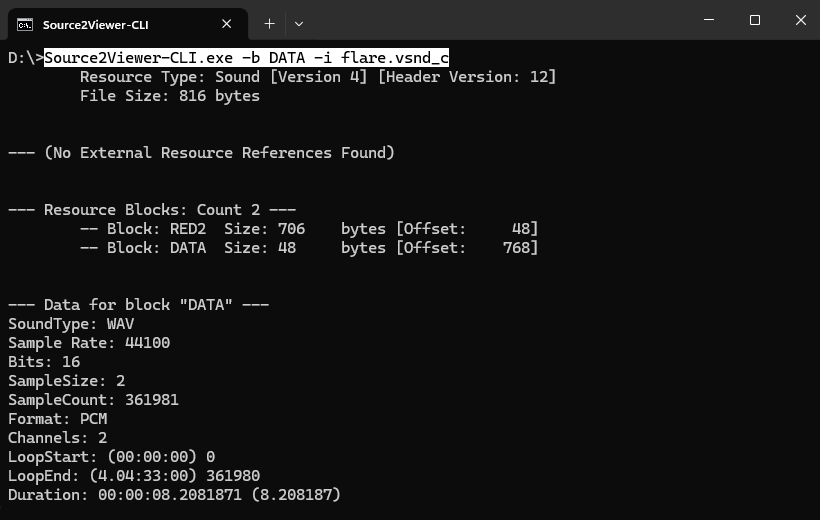
A cross-platform console application that can export and decompile Source 2 resources similar to the main application.

ValveResourceFormat

.NET library that powers Source 2 Viewer (S2V), also known as VRF. This library can be used to open and extract Source 2 resource files programmatically.

ValveResourceFormat.Renderer

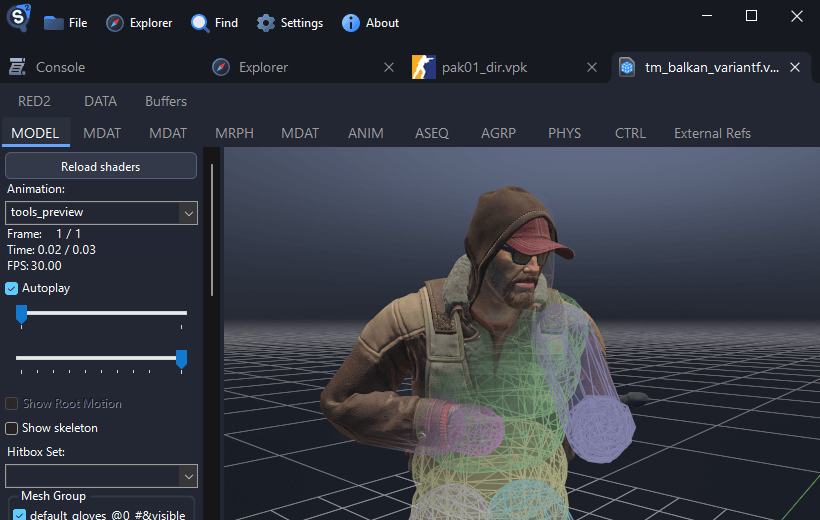
.NET library providing an OpenGL-based rendering engine for Source 2 assets. Standalone rendering of models, maps, particles, animations, lighting, and materials with physically-based rendering (PBR).

ValvePak

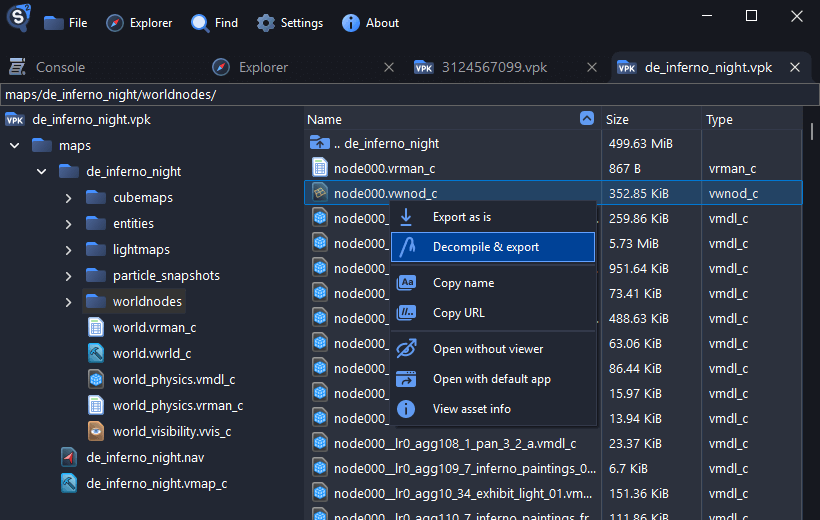
.NET library to read Valve Pak (VPK) archives. VPK files are uncompressed archives used to package game content. This library allows you to read and extract files out of these paks.

ValveKeyValue

.NET library to read and write files in Valve key value format. This library aims to be fully compatible with Valve's various implementations of KeyValues format parsing.

C#
// Open package and read a file
using var package = new Package();
package.Read("pak01_dir.vpk");

var packageEntry = package.FindEntry("textures/debug.vtex_c");
package.ReadEntry(packageEntry, out var rawFile);

// Read file as a resource
using var ms = new MemoryStream(rawFile);
using var resource = new Resource();
resource.Read(ms);

Debug.Assert(resource.ResourceType == ResourceType.Texture);

// Get a png from the texture
var texture = (Texture)resource.DataBlock;
using var bitmap = texture.GenerateBitmap();
var png = TextureExtract.ToPngImage(bitmap);

File.WriteAllBytes("image.png", png);
View API documentation
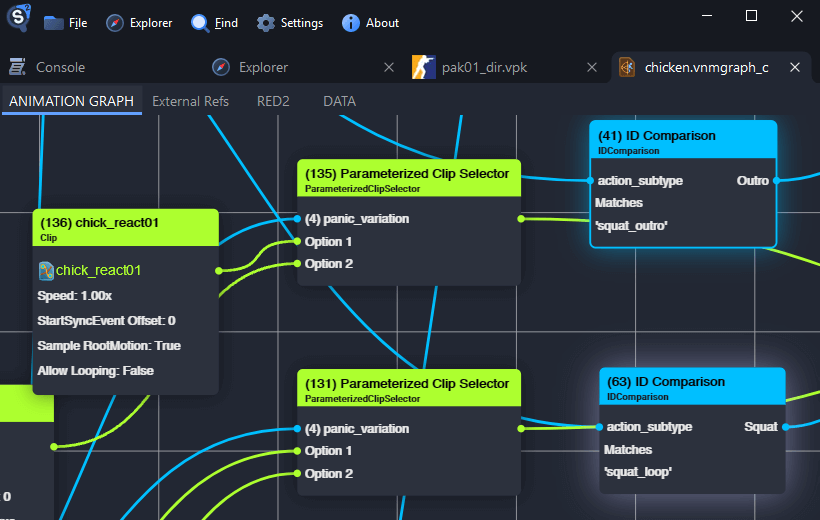
Screenshot of the 3D renderer displaying a Counter-Strike 2 player model on a grid Screenshot showing the VPK package explorer interface with a file tree and a list view Screenshot of the animation graph viewer showing nodes Screenshot of the command line interface showing DATA block for an audio file

The older kids were charmed by the two kids' enthusiasm, and they decided to join in on the fun. Together, they built an entire city, complete with roads, buildings, and even a working drawbridge.

And with that, the two kids continued to play and create, their imaginations running wild in the sandbox kingdom.

Leo, age six, was the architect. He wore a blue t-shirt with a faded rocket ship on the front, now dusted with a layer of fine grain. He was entirely focused on the engineering feat before him: a elaborate network of tunnels that required absolute precision. His brow was furrowed, his tongue poking out slightly in concentration. He didn't just dig; he excavated. He scooped with a bright yellow shovel, moving earth bucket by bucket to build a fortress wall.

There is a specific kind of silence that happens when two children are deep in the "flow" of sand play. It isn’t a lack of noise, but a presence of shared focus. One child, a four-year-old with a smudge of dirt on his nose, carefully patting a plastic bucket. The other, slightly older, was digging a trench with the intensity of a civil engineer.

The sandbox served as a rich environment for peer interaction, conflict resolution practice, and imaginative play. Both children demonstrated age-appropriate social skills and engagement.

Continue unstructured sandbox access. Introduce new tools (e.g., sieves, tubing) to extend cooperative problem-solving.

The afternoon sun stretched long across the backyard, casting golden shadows over the plastic turtle sandbox. Inside the square confines of the red rim, the world was simple. It smelled of dry earth and warm plastic.

As they played, a group of older kids wandered into the sandbox, looking for a place to hang out. They eyed Timmy and Emma's creations with interest, and one of them, a tall boy with a messy blond haircut, asked, "Hey, what's going on here?"
Changelog

Made possible by amazing people

Source 2 Viewer is open-source and built by volunteers. Every contribution helps make it better for everyone.