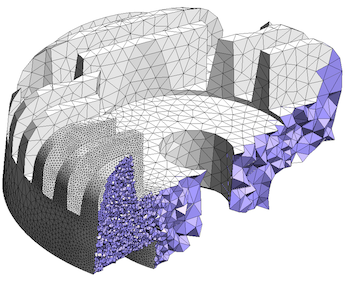
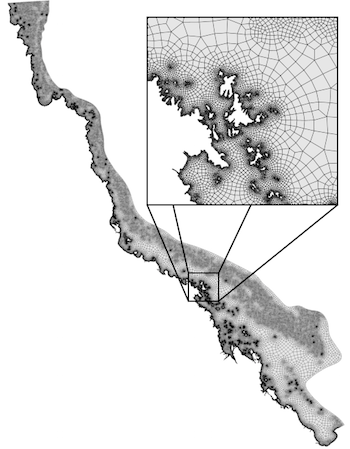
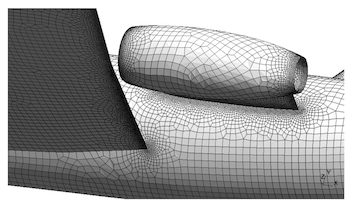
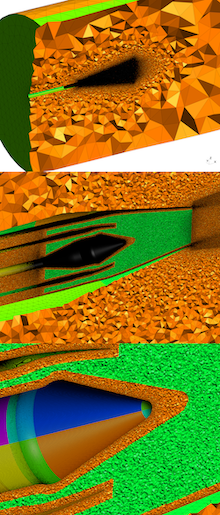
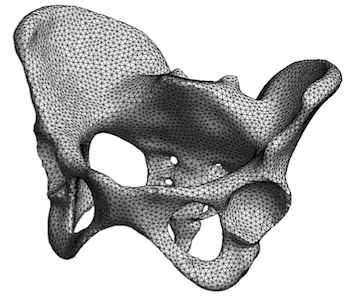
Gmsh is an open source 3D finite element mesh generator with a built-in CAD
engine and post-processor. Its design goal is to provide a fast, light and
user-friendly meshing tool with parametric input and flexible visualization
capabilities. Gmsh is built
around four modules
(geometry, mesh, solver and post-processing), which can be controlled with
the graphical user
interface, from
the command
line, using text files written in Gmsh's
own scripting
language (.geo files), or through the C++, C, Python, Julia and
Fortran application
programming interface.
See this general presentation for a high-level overview of Gmsh and the reference manual for the complete documentation, which includes the Gmsh tutorial. The source code repository contains the tutorial source files as well as many other examples.
Gmsh is distributed under the terms of the GNU General Public License (GPL):
pip install
            --upgrade gmsh
'
Make sure to read the tutorial and the FAQ before sending questions or bug reports.
git clone
          https://gitlab.onelab.info/gmsh/gmsh.git
'
pip install -i https://gmsh.info/python-packages-dev
        --force-reinstall --no-cache-dir gmsh
' (on Linux systems without
X windows, use python-packages-dev-nox instead of
python-packages-dev)
If you use Gmsh please cite the following reference in your work (books, articles, reports, etc.): C. Geuzaine and J.-F. Remacle. Gmsh: a three-dimensional finite element mesh generator with built-in pre- and post-processing facilities. International Journal for Numerical Methods in Engineering 79(11), pp. 1309-1331, 2009. You can also cite additional references for specific features and algorithms.
Please report all issues
on https://gitlab.onelab.info/gmsh/gmsh/issues.
Gmsh is copyright (C) 1997-2022 by C. Geuzaine and J.-F. Remacle (see the CREDITS file for more information) and is distributed under the terms of the GNU General Public License (GPL) (version 2 or later, with an exception to allow for easier linking with external libraries).
In short, this means that everyone is free to use Gmsh and to redistribute it on a free basis. Gmsh is not in the public domain; it is copyrighted and there are restrictions on its distribution (see the license and the related frequently asked questions). For example, you cannot integrate this version of Gmsh (in full or in parts) in any closed-source software you plan to distribute (commercially or not). If you want to integrate parts of Gmsh into a closed-source software, or want to sell a modified closed-source version of Gmsh, you will need to obtain a commercial license: please contact us for details.
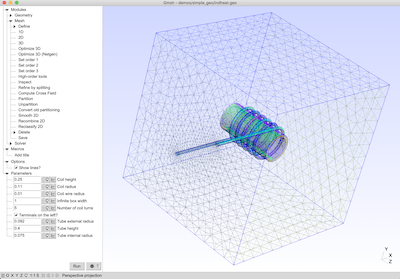
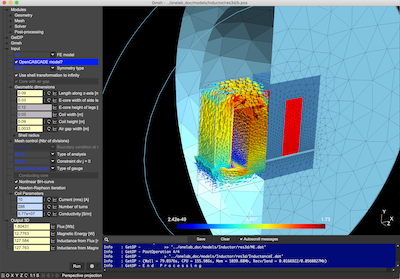
These are two screenshots of the Gmsh user interface, with either the light or dark user interface theme. See the ONELAB web site for more.
Adobe Photoshop has long been the industry standard for raster graphics editing. Prior to the release of Creative Suite 6 (CS6), the software had incrementally improved upon existing paradigms. However, the release of Photoshop CS6 Extended represented a fundamental shift in both the user experience and the underlying processing architecture. Unlike the "Standard" version, the "Extended" variant was specifically tailored for cross-disciplinary professionals, including video editors, architects, and medical imaging specialists. This paper examines the architectural changes and feature sets that defined this iteration of the software.
Photoshop CS6 Extended introduced several "Content-Aware" technologies that felt like magic at the time and remain functional today. photoshop c6 extended
Photoshop CS6 Extended vastly improved its 3D toolset. The new 3D engine allowed users to extrude text and paths into 3D objects with surprising ease. Features such as changing the camera view, adjusting shadow fidelity, and altering ground plane reflections became accessible to 2D artists without requiring them to learn complex CAD software. The software supported 3D file formats such as OBJ, Collada, and 3DS, bridging the gap between graphic design and 3D modeling. Adobe Photoshop has long been the industry standard
Introduction to Photoshop CS6 Extended's New 3D Capabilities Unlike the "Standard" version, the "Extended" variant was
The Mercury Graphics Engine utilized graphics processing unit (GPU) acceleration to execute pixel manipulation in real-time. By offloading processing tasks to the video card, CS6 achieved fluid, near-instant feedback for brush strokes and complex transformations. This architectural shift not only improved efficiency but also allowed for the handling of significantly larger files and 3D assets without compromising system stability.
Advanced video editing capabilities that were previously restricted to Extended users, though CS6 eventually moved basic video tools to the Standard version as well. Game-Changing Features